
Rehearsal Report – Difference and Repetition (Translation to english Chat GPT)
Report Thursday, March 26
The day started as usual. When I peek through the door to Studio 1, Saila is already there. She’s sitting and working on her things. The script is on the table in front of her. It’s starting to take shape. I come in with a slightly restless energy because of finances. But Saila calms me down, helps me send an email and so on. Things work out!
Then we dive into the script. We go through it scene by scene. We remember quite a bit from the beginning, but it gets more and more difficult as we go along. I have faith. Fredrik arrives. We get started. Some new adjustments in scenes, some new thoughts. We talk about how this script could become something that can be passed on to others—a teaching piece, perhaps.
Kai arrives for lunch. We do a run-through of what we have so far. Afterwards, we talk about it. What he saw, what puzzled him. The Shakespeare quotes, for example. And that B is actually X. For me, it has been obvious and implicit that B doesn’t need to be a psychologically realistic role, or even a “person.” For me, B is anyone or anything—but something in between A and C. Something that arises in between. But perhaps it’s clearer to call it X. And what about all the other letters?
Short report. Looking forward to tomorrow. Per is coming! It’s good to have more people in the rehearsal room. Then things arise that the three of us haven’t seen, can’t see. Easter is coming soon as well.
March 24, 2026
We are diving into the material, trying things out, losing ourselves, testing old tricks, going back, messing around, tasting it, rearranging. I was reminded of snow and all the different names the Inuit have for it. I think they have something like twenty-seven different terms because they’ve been working with snow for thousands of years. That’s what we’re doing now.
I’m still not entirely sure whether we have enough textual material, enough density, enough time filled so that this “third” can arise in the performance. I know that this third is connected to time—it takes a certain duration for it to emerge. The audience has to lose themselves a little, where time and place dissolve. I also know it has to do with boredom—that moment when you start wondering if this might not be so good, when a kind of emptiness appears. An emptiness that can then be filled with what arises inside me in relation to what I see.
I know it also has a lot to do with light/sound/space, which we haven’t worked that much with yet. So it’s only when we get to work with all the components that we can really sense what we have. What we are working on now is a kind of readiness, I think—a way of making ourselves receptive to this encounter.
March 18–19
Present: Solveig, Fredrik, Jakob, Camilla and me.
On Wednesday, Jakob and Fredrik picked up the screens from storage and some other things. It was really good to bring Jakob into the work. Immediately it felt like the space tightened with the light coming from the screens. As actors, we get something concrete to work against when the space becomes clearer. This is only the beginning—the first day. It will be exciting to see how the space develops. First at Loft 1, and then it will just grow bigger and bigger. First scene 3, and by August scene 6.
Yesterday we created a sequence that we used as a starting point today when we talked through the text in the morning. Fredrik came with a new sequence that we began working through. It’s starting to take shape—all the different elements are beginning to merge. We all agree that we don’t want to fall into a kind of “pseudo Jon Fosse” tone in the text, so we are consciously working against that.
Solveig and I are trying to find our own acting mode, something that belongs only to the two of us. It really helps to bring in Jakob’s screens—they create both atmosphere and resistance to work against.
We mix elements from Verk’s previous works—Solaris, Wishful Beginnings, Evige Leendet—as fragments that are transformed into something new in this space between us. They feel like echoes from the past—ghosts haunting us in this room when we activate or initiate movement.
There’s a lot of beautiful sound and music that Fredrik improvises, which inspires and helps us as actors to find different levels in the text, where it begins to feel right to perform it.
There is still a lot to discover in the dialogue, especially in the pauses, the rhythm, and where the text should be directed. I feel that Solveig and I are starting to find something between us in the dialogue. I’m looking forward to knowing the text and being free from carrying the script around. It will be good to find presence from within, and to explore the organic in the body in the space together with the text, sound, and light.
Here is the sequence we liked today:
• Intro – Saila, the real situation
• Funes in mic – Saila
• Solveig present in the space – sitting and listening
• “It’s nice” – dialogue – Saila / Solveig
• Solaris walk at the back – ends at mic – Shakespeare – we actors are only spirits – Solveig follows, switches sides
• Spirits – dialogue Saila / Solveig – Jon Fosse story – dialogue continues
• Solaris spirit text – Saila – dance Saila and Solveig – we walk behind the mirror scene from Solaris with large shoes (maybe without the mirrors?)
• ABC dialogue – Saila / Solveig – ends with ABC improvisation
• Solveig – Hamlet text – Saila goes behind, puts on the goat mask and stands there
• “What is an actor?” – argument between Saila / Solveig
• Solveig – slapstick scene – ends lying on her stomach in front
• Time – dialogue Saila / Solveig
So far so good. To be continued.
Good day.
March 16–17
Present: Fredrik, Solveig and me. Per, Camilla and Jakob dropped by after lunch.
We are exploring whether we can transfer the choreographic thinking and structure of Rosas danst Rosas into our work with text, body, and structure. We create a small sequence where we first improvise text, then only movement/choreography, and then text together with movement. Finally, I perform the movements as my part of the text, while Solveig only speaks.
There are countless variations we can develop from this principle. Solveig pointed out a kind of 90s entry point, while also reflecting that if we draw inspiration from Rosas, perhaps we are moving toward something new. Should we instead look back at our own work with Verk? Wasn’t that the project—Verk plays Verk? Not necessarily starting something new, even if something new may emerge in the process.
She has a point worth considering, regardless of whether we follow that direction or not.
We sit around the table discussing what kinds of “mathematical” starting points we can create and test on the floor. Rosas works from body, choreography, and rhythm—can this be transferred to our text work? In any case, it’s inspiring to let ourselves be influenced by her work and see where it leads.
We read through the text we’ve worked on so far and see that some passages need revision and cleaning up.
On Tuesday, Solveig and I continue working with the text. We run it three times with slightly different approaches each time. The last run-through felt best. We listened more to the text and based it on the real situation: it’s Solveig and me trying to figure this out—what is theatre?
We let the text affect us, rather than imposing a specific attitude on it. The situation grows out of listening. At the same time, it’s challenging to work physically when we don’t yet know the text and have to carry the script around.
The next step might be to work more deeply with shorter text sections. At the same time, it’s important to grasp the whole: what are we actually dealing with? Maybe we can divide the day in two—one part for working on the whole, and one for diving into shorter passages.
From the inside, it feels like the most organic level is a grounded, listening-based approach. From there, transitions can occur between reality and fiction—from the here-and-now to more poetic images in the stories we tell. Also images without text—just space or movement.
A good day. It was nice to have the calm to simply be in the text together, without sound or other elements. It also makes it clear how important sound is in creating something alongside us—something more than just two actors speaking.
It will be good to bring the other layers into the space and see how they activate something new alongside the text.
Thursday March 5 – Saila, Solveig, Fredrik (notes)
Friday March 6 – Saila, Solveig, Fredrik, and Per and Camilla from 13:00
I will try to summarize two days. It’s not as easy as one might think, because a lot happens.
On Thursday we attempted a kind of forced run-through of all the textual material we have. The day before we arranged a sequence and then we plowed through it. It is always painful. But it is good, because you begin to sense what works and what doesn’t. I know that this is actually a lie, because I know that we know that it is such tiny things that make something work or not work. But in any case, you can at least see that something works or doesn’t work. The problem is that you don’t see why it doesn’t work—you only see that it doesn’t work. But that is still a step forward, because I saw that what worked was the first scene. So I quickly entered an artistic crisis for the rest of that day, though I kept it at a distance. I think I have become quite good at that over the years—not letting myself be too affected, just continuing. But it was there the whole time. I tried to ignore it, but it was there, very close. It is like a color. Very dark, deep red, almost black—a mixture of black and red. Quite suffocating.
The next day was clearer, much more air, with shades of white. I went into what worked—the first scene—and expanded it, merged some other texts into it. Added some things and removed others. We read it together. I am reminded of something Deleuze wrote. A kind of recipe, freely paraphrased:
Settle yourself in something familiar, somewhere you can stay.
Examine and experiment with that place and the possibilities it offers.
Find possible movements out of that place, small cracks.
Possible escape routes. Experience these lines of flight, these cracks.
Create new connections and combinations by contracting, binding things together.
Always try to preserve a small piece of what newly emerges.
Through meticulous handling of things, one can manage to release lines of flight.
We talked about forcing things—forcing a structure—and agreed that it was good that we did that the day before. We also spoke about this new thing we were going to try, and that this felt better.
Then Per and Camilla arrived.
We told them a little about the project. Fragments. It was nice. They are so attentive. It is as if the project becomes bigger in their presence. Good questions. We showed a reading of the expanded version of the first scene, plus a little more. We were quite unanimous that the first scene works. The pauses. The spirits. The sense of wonder.
We talked about possible directions. The last thought I had that made sense was:
Maybe we just do this same scene.
Again and again.
Then we don’t have to write more text.
Difference & Repetition.
March 4, 2026 – Wednesday / Loft 1
Present: Fredrik, Solveig, and myself
Fredrik had met a colleague of ours yesterday evening at the climbing gym. This colleague told him that he had studied theatre history at the university, where he had been told that theatre is when A plays B and C watches. Fredrik was inspired by this short encounter and wrote a continuation of the first part of the text.
The first part of the text functions as a prologue, a key scene, or a chaussette, which means:
In some scenic or technical contexts, chaussette is used metaphorically or technically for something that gathers, encloses, or wraps material. In certain scenographic or performative practices it may describe:
-
a “sleeve” or fabric pouch that gathers material
-
a condensation or collection of scenic material into a single form
-
a textile structure that holds something together
For that reason, in artistic conversations the word can also be used more poetically to describe a condensation of material within a performance.
After some coffee and morning conversation, we went onto the floor and continued improvising around Section 1, “What is theatre,” and dove further into “The Spirits.” We continued constructing the text, inserting the new improvisation The Spirits together with the opening. We also inserted the Spirits text—my/Adam’s text from Solaris—followed by a dance behind the strip of light on the floor.
We continued the construction work by reading texts aloud. Solveig performed the Hydra text by Heiner Müller into a microphone, and I read the Fear text sitting on a chair into a microphone. We observed that these texts fit well together.
We then rediscovered a text we had forgotten: the TIME text, which led us further into our associations with Wishful Beginnings, the opening scene between Solveig and Espen. Solveig interviews Espen, and Espen quotes Hamlet. We transcribed the Hamlet passage and included it in the TIME text sequence. Once again we observed that these texts—Hamlet and our own TIME text—fit together.
Here is a list of today’s new texts:
-
Hamlet
-
The Spirits
-
TIME text
At the very end we began organizing a provisional order of the texts we currently have. There is more text now than there was in Solaris. Much still remains in discovering whether the sequence is the right one, and which texts will ultimately belong within the concept.
For now, we are working with three levels:
-
Dialogue between Saila and Solveig
-
Fiction texts / stories delivered into a microphone
-
The backstage space with dances and physical images
March 3
KHIO – Saila, Fredrik and Solveig (notes)
I started my walk down to KHIO from Torshov listening to the song “Du gråter så store tårer nå for tida” by Ane Brun. I had to pull myself together not to start crying out in public. I didn’t want to be that woman walking down the street sobbing. But I had it in me today.
Maybe because everything feels so unsettled in my world—both in the wider world we live in and around us, but also because I’m about to sell our home. I don’t know where the next place will be. I’m cleaning, sorting, painting, trying to make everything as beautiful as possible so that people will bid lots of money on my apartment, so that I might be able to afford to buy something somewhere else. And I hate that this is how it works—that prices are pushed higher, that we squeeze everything out of each other. It’s such an idiotic thing, really. We are talking about something as basic as having a roof over one’s head.
When I arrived at work, we started talking about fear. About the machine that is taking over. About the train that just keeps rolling and we have no choice but to jump on. That hit me hard.
We talked about being afraid of emptiness—what happens to us then? About standing in not knowing, being in the unknown, daring to acknowledge helplessness, daring to be uncertain. And of course there are so many methods and roles and paths already laid out that one can follow. One can lean on conventions and rules, finish the assignment, keep one’s back covered. But those paths are often—how should I put it—on those paths you may not discover much that is new. You simply fill in the forms, color the right squares with the right colors, and then everything is understandable and nice. Everyone understands everything and there is nothing left to wonder about. The audience is pleased, everyone did such a good job, thank you and goodbye—and by the way, do you have a TV series to recommend?
Perhaps that is a kind of slow death. A stiffening. But everyone is satisfied because fear is no longer so present—it has been wrapped up, dampened.
It felt good to be on the floor today. It felt good to put on a cap and disappear into something else, become someone else. It felt good to read Heiner Müller’s hydra text, about the man who fights a monster in a forest and eventually realizes that he himself is the monster he is fighting.
It was good to be on stage with Saila. It is exciting when the texts we have become something more than words on a sheet of paper. It is exciting that we can be together and work toward something we don’t yet know what is, but which is interesting to try to discover. It is good to share thoughts, to receive new thoughts into one’s head. It is fun to turn off the lights and see if we discover something there in the dark.
The orange cloak was so beautiful when it suddenly began to rise upward and upward. Not entirely by itself, of course—but that doesn’t matter. Imagination takes care of that part. Haha.
When we finished one of the improvisations, I pulled a white skirt over my head and pretended to be a ghost for a few seconds.
It was liberating.
Monday, March 2 Present: Solveig, Fredrik and myself. Jakob dropped by after the break.
We moved into Loft 1. It felt good to enter Loft 1. Even though Loft 2 is also a good space—bright, warm, with a beautiful floor—it somehow felt better to be in Loft 1. It is a slightly rougher room, with a completely black floor, which makes it easier to gather concentration and focus on the material, I think.
Fredrik had been thinking over the weekend. He spoke about the thingification of theatre and of the actor. About exposing theatre and the theatrical space. About creating frames and limitations for the project so that it does not spill out in every direction.
When does the actor become something more, something else?
Fredrik suggested that we explore objects, props, and costumes that have been used in previous works by Verket—examining them in a new context and seeing what new images and meanings might begin to emerge.
We want to tell and bring forward several stories. For example: Borges’ Collected Fictions, Sophie Calle’s Pictures That Had Been Stolen from the Museum, Edvard Munch’s paintings that he left in the forest so that trolls could leave their marks on them, Solveig’s Gwinplay story, Fredrik’s Mnemosys story about the boy who fell from a horse and gained total memory, as well as stories from Fosse’s Septology: “picture with a line” and “the color brown”.
We improvised by telling small stories about our own productions. Solveig spoke about The Big Dream, Fredrik about Stalker, and I about Iphigenia—and all of us about Evige leendet.
Solveig and I created new choreographies and learned each other’s. We continued improvising with props, exploring what happens between two props when we bring them out and place them next to each other. It was fun to perform simple, neutral actions and see whether something begins to emerge from that.
After the break we talked about the space together with Jakob. He suggested a strip of light made from the screens placed on the floor, crossing the entire room. We taped the spot on the floor where we imagine the strip of screens might be placed.
Afterwards we read the first section of the text and showed the new choreographies to Jakob. We all agreed that the music helps a lot in finding the depth and resonance of the text. We like that Fredrik improvises with sound, because it activates another layer, and the text begins to live in an unpredictable way. Later on it may well be that we don’t use sound with this particular text, but for now it feels important to throw ourselves into it and try different variations and soundscapes in order to break open new meanings.
Friday, February 27 – Saila, Solveig, Fredrik (notes)
The last thing said on Friday:
The actors are guides (à la Peking Opera) who open up the inherent power of theatre. We don’t need to bring the stories in from outside—they are inherent in theatre itself. “Beautifully said,” Solveig said, “but easier said than done,” I think.
The idea was to keep it simple.
To show the simple shifts.
Between reality and fiction.
Maybe talk about it.
Is it possible? We did it. It’s possible.
Theatre thrives on metaphor.
Things stand for things rather than being the thing itself.
Is it a demonstration of the moment when metaphor arises?
I thought about that.
I thought the actors could walk around the space.
Map it. Tell us about it.
Here is a large light screen illuminating the room.
Here is a threshold.
If you cross this threshold, something changes.
A light. A sound. A different way of walking.
How do you create a performance?
What is the purpose of theatre?
We talk a lot about Reality – Fiction. About the twist. When this twist happens. In the space. That’s really what the performance is about:
This sliding.
How little or how much is required for it to occur.
The performance is a materialization of theatre’s codes.
How do we materialize theatre’s codes?
A writer is someone who creates a language.
We create a language.
The language of theatre.
Can we create a world with tape?
It’s a play with metaphors.
The Black Box is a threshold in itself.
It’s a zero point.
The actors insert signs:
Theatre – Performance – Actor – Performer – Choreography – Dance – Visual image – Costumes – Clothes – Sound – Scenography – Light – Props – Threshold – Transitions – Portal – Symbol – Reality – Fiction – Pause – Rhythm – Psychology – Subtext – Dionysus – Mnemosyne – Stories – more…
All the objects of the Work are displayed in the space. Or we place all these objects out. At the beginning of the performance.
They are the Verk’s primordial props.
They can be combined in countless ways.
One actor can put on the goat mask, while the other presents the axe.
One actor can lift the axe,
while the other is about to say something into the fur-covered microphone stand.
Combinations of images. They open new spaces. It’s a play of different combinations.
Give the audience time.
Wait for a long time.
To activate the audience, you must deactivate the actor.
It is impossible that nothing happens.
As long as there are people, something happens.
We talked about stories. That we need stories. We love stories. What is a story? What does it do to us? Can we investigate that? We love the Commedia dell’arte story. It maps a space. It provides limitations that in turn create possibilities. Whispering corridor. Then I can go in there and whisper. That is the threshold. The audience loves it—entering the game/fiction. That’s what we do. Are stories the image from which the light emerges?
26 February KHiO, present: Saila, Fredrik and Solveig (reporting)
The last few days have been full of laughter. We have laughed at the texts we’ve produced. We’ve interviewed each other — first writing questions, then asking them, trying to answer as honestly and precisely as possible. I think I laugh to defend my own lack of knowledge. It becomes so clear that I cannot put precise words to what theatre is, what time is, what an actor is, what fiction is, what presence is. I am always searching for the spirit — not a religious spirit with great power, I just call it spirit for lack of a better word. I want to go beyond and into it — “the other.” The unnameable.
We’ve been on the floor, trying to speak the words we’ve created, to perform them, to place them in the room. In different ways. We stand, we sit, we try to say the words in an exaggerated manner — how shall I put it? With exaggerated gestures, exaggerated vocal tone. We give the words a colour, tint them with even more empty-head attitude.
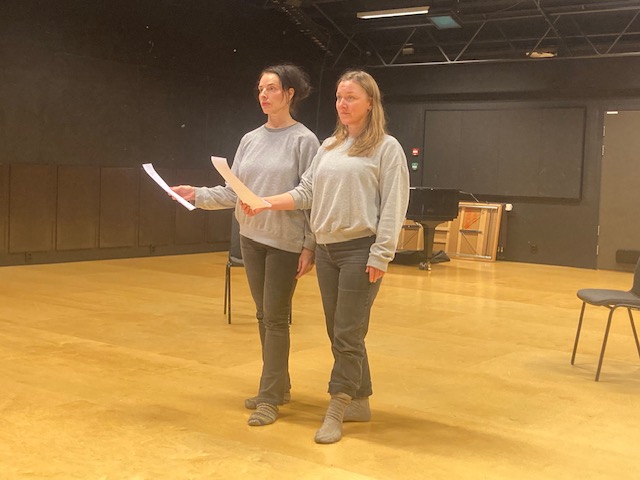
Some of the texts are beautiful. Some of them are striking. It’s fun to do this work, and it’s fun that it moves so fast. We have an incredibly efficient factory running. Talk a bit, write questions, ask and answer them, run the audio file through the machine so it gets transcribed, print it out, read through it, make quick edits, print again, up on stage, cross out what doesn’t work. Or try it another way.
Choreography — we’ve used the same one we did in Solaris. It’s nice to work with something we already know. Something that lives in the body. I also think it would be exciting to create a completely new choreography. To fill things up.
Fredrik told a story from Jon Fosse’s Septology. I need to read that book. It was very beautiful to receive a story. That’s really all I want. To receive stories and to tell stories. I think that would be enough.
It’s difficult to make theatre out of what we’re doing now — does it actually become theatre, or does it become more of a lecture? Where is the core, the drama? What is this performance, Difference and Repetition, actually meant to tell?
I notice that even though I really enjoy working with self-produced text, I still feel a longing for a good story, or something that is truly written. Maybe that’s why I was so happy hearing Fredrik tell that story. Because then suddenly something happened. I was somewhere else. I was carried across.
25.2.26 – Wednesday Present: Fredrik, Solveig and Saila, who is writing today’s report.
We began today’s work on Stage 6. “There’s something nice about changing rooms,” Fredrik said, and I can agree with that. It is good to actually experience the large space where we will present the final version of Difference and Repetition.
We continued where we left off yesterday, with Peggy Phelan’s idea: “Art of writing towards disappearance rather than towards preservation.” What does she really mean by “writing towards disappearance”?
How does one write about art? We have no answers, but I thought of Tommy Olsson, who writes art criticism. His way of writing is to begin from a strongly personal position. I always find it exciting to read his reviews precisely because he dares to write about what the art he has experienced sets in motion in him, rather than necessarily what the art means or whether it is important in society. It could be interesting to speak with Olsson and some other art critics about why and how their involvement appears in the writing process. When it becomes personal — whether it concerns art or an encounter with another human being — that is when it begins to interest me.
We spoke about an investigation of the kinds of challenges an actor encounters in their work, à la The Five Obstructionsin Lars von Trier’s film, where Jørgen Leth is given various constraints he must relate to. This can be seen as the limitations or resistance we meet in our own practice.
What concrete situations can we set up for the actor? That is a question we asked ourselves, and one we have not yet answered.
Different questions can function as transitions into an action, an improvisation, or further into a new question. For example: What is authenticity? What is real?
We delved into words such as equivalence, metaphor, metonymy, and allegory.
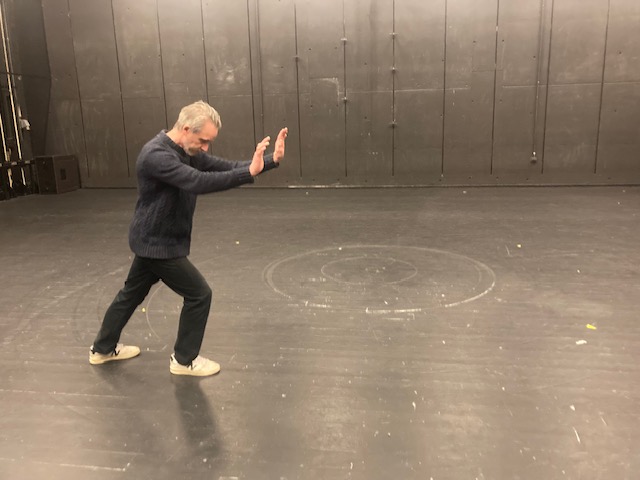
It was good to reflect on these concepts that we perhaps take for granted, and that I at least often forget the meaning of. They can be seen as building blocks for creating the new realities we are in the process of exploring and constructing.
Attempt 1:
Solveig and I each took a text we know by heart and sat on chairs on stage. We gave each other tasks, for example: “Say the same text again, but imagine that you have a thousand people watching you, and that you must reach all of them.” We agreed that it was a failed attempt. If we use a text from one of the performances we have done, it is better to perform it as we did at the time, and instead explain how we arrived at that version of the delivery.
Attempt 2:
We read through the transcribed text between Solveig and me and switched roles. We think the text works, but it needs to be cleaned up. We had fits of laughter reading it.
Attempt 3:
New questions and a situation in which we interview each other. We recorded the improvisation, which will be transcribed afterwards. Questions about time, what is fiction and what is reality, and other questions.
Monday 24 February, KHiO, Loft 2. Present: Solveig, Saila, Fredrik(Referent)
We talked about how the process notes have the same quality as what Peggy Phelan writes about in relation to performances that disappear from memory once they are over. Performances resist the circular economy and instead celebrate the idea that a few people, in a specific time and place, can have an experience of value without leaving any visible trace afterward. If one is to write about a performance, one must write toward its disappearance rather than write in order to preserve it. The after-effect of disappearance is that the subject emerges. That’s beautifully put.

We talked about Rauschenberg, de Kooning, and Vibeke Tandberg, who erase the image—frenetically, erasing and erasing until only a few small marks remain, the contours of an erased line. This sieve that filters out the sand so that the invisible gold can appear.
I sense there is something here. In this project. And in truth, it has been a project for a long time. What was wonderful about Stalker was all the coffee cups, the cinemas, the sense of time, and the digressions that had nothing whatsoever to do with Stalker, yet somehow did. This space.
We went on to discuss whether we should ask others what they remember from our performances. Instead of Stalker, they could speak about a Verk performance. About time, about smells, about the atmosphere in 2007 when they saw Iphigenia. That is one possible path, a trail we could follow. It’s about creating traces outward, small paths. There is something strange about these processes—how one ends up pursuing certain tracks. You never quite know which track will capture you, which will show the way. Perhaps it has to do with light—that you sense clearings a little further down the path. One cannot walk too long in the dark.
We gathered the texts and situations around what we experience as “thresholds” in Solaris and The Big Dream. I think we are all very fond of thresholds. I can feel it in the room—there is something fantastic there, a light, in transitions, portals into the indescribable. What can a PhD do with a flowing, fat, juicy threshold? Ha!
I know we wandered around with the printer and managed to print out a number of threshold texts. I also printed a text I had written that approaches the actor and the theatre in a more etymological way. We tried it out. There was something simple and beautiful about it. We think it could be a good fundamental situation. We like fundamental situations. A place to rest, where the actor can breathe—the place where one breathes. Together with the audience. It doesn’t have to be a unique place; it is something recognizable, like the desktop on a computer. Recognizable, partly manageable—and the moment you start clicking into folders, an infinite number of folders and documents open up and can quickly become overwhelming. Then it is comforting to return to the desktop and see that it is still quite safe and fine after all. It’s not a perfect image, but I think of it as a kind of interface. The fundamental situation is the interface—for both actors and audience—a space that is good to inhabit before diving into more unknown terrain.
In any case, a fundamental situation emerged. We liked it. We stayed in it for a long time. Things slowly began to grow forth. Something other than just the text I had written about the actor. We wrote down questions. Questions about the actor. They were good—simple and at the same time complex. The actor tried, as best she could, to answer them. One moment in particular made an impression: the idea that as an actor, you must do things for real and not pretend. Can you stumble and fall for real on stage?
She tried.
It is impossible.
She tried again. Several times. We laughed.
We sound recorded the entire session.
Monday 23 February, KHiO, Loft 2.
Present: Saila, Fredrik, Camilla (until 11:30), Solveig. Jakob arrived after lunch. We then moved down to Stage 6, where we will actually present the work in April (work-in-progress showing) and in August (PhD evaluation).
The title is bold. It borrows directly from Deleuze. It is almost pretentious to call the performance Difference and Repetition. And why is it in English? Would it be better in Norwegian? Forskjell og repetisjon. Verk has almost always had English titles. Are we cooler than we are? After all, we do have international ambitions. This performance has an international potential (haha — remember where that comes from??). There is something there.
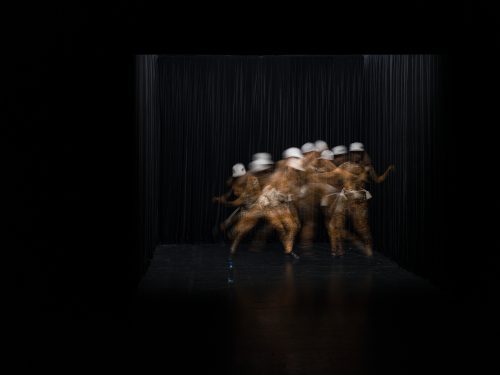 It is written in Saila’s notebook. She works a lot with Braidotti in her work at KHiO. This performance revolves around dissecting theatre and the actor’s work. We want to open up how we work. The ensemble. The entire room. Light, sound, space, actors. Simple. To show how — but it is damn difficult. Difficult to articulate. Maybe we circle around what cannot quite be said. Or encountered. It feels almost blasphemous. Almost naively simple. What are you doing? I don’t know.
We can frame it conceptually. Show and tell. But why should we tell? And to whom? What audience do we imagine? Perhaps more directed toward people already interested in art. There is freedom in not having to reach a broad audience. Performing it here (KHiO) gives a different starting point. It allows for a kind of nerdiness. That could be interesting.
Jérôme Bel — showing practice, context, the body as history.
Isadora Duncan — the way she constructed dance. A 70-year-old dancer. Beautiful. Organic. She came from ballet but wanted to renew dance. Not artificial. Early 1900s. “The story of.”
Sophie Calle. Unmarked (Peggy Phelan): 13 images stolen from an exhibition in Boston. Empty frames. The audience was asked to describe what they remembered. Transcriptions of memory. Reconstructions. Activation of the audience’s memory. Is what they remember more interesting than the image itself? Or what remains of an artwork once it is gone?
Solaris: the masterpiece removed from our performance — the resonances are all that remain. A kind of documentation of resonances. Documentation of the encounter with the film, the book, and ourselves. Book – film – performance. Geoff Dyer, Stalker: the artifact. We mix in our own thoughts.
It is about displacement. A turning that dissolves time, that opens up — a grenade, the vertical. What is real? Multiple perspectives without turning into hocus-pocus meta-chatter. What is the original here?
Saila. Everything Verk has done up until now.
Saila’s journey. The actor today. The beginning. The journey. Memory narrative. Verbal and physical. Images and memories. Rehearsing on the floor — but the body can no longer do the same. Thirty years older. The axis of time. Aging? No. Time. Life. Death.
The body 40 years ago.
Should we tell Saila’s life story? Or let it seep through?
The structure of the Isadora Duncan performance (Jérôme Bel):
-
Biography
-
The movement – étude
-
What it means – text
-
Music on – text removed
-
Études assembled
-
Audience invited to participate, to do the same
Camilla: Time and ideologies. The ideals embedded in all practice. What one once believed in — what has shifted. Ideals come and go. Ingmar Lindh. The fall of the Berlin Wall. Geopolitical changes.
When Saila and Fredrik started, the world was different. It can be compared to what is happening now. Colonial movements — the journeys went in one direction. To the East. Peter Brook. Travel out, learn, bring it home. A privileged position. Everyone went to India. Today we look at that differently. Crediting. Awareness. Exploitation. Who do we learn from? Who do we steal from? We stand in a context. We are not alone. Who is Verk? How is our material created?
Possible starting point: Solveig tries to understand Saila’s acting practice. Saila’s references, experience, knowledge, doing. The seven most important things. Solveig follows Saila. The wordless knowledge. Solveig has been apprenticed. The performance begins in 2006. Iphigenia. First time Solveig worked with Verk. Academy of Performing Arts. Per aspera ad astra. — Saila does not want to lose hope. Through the dirt toward the stars.
The world situation
The world has changed in 30 years. Toward a multipolar world.
US hegemony fading. Europe more alone. We have outsourced production — we can consume, but not produce. Saila feels art was richer before. More was invested in culture. Kaja-funding. Anders Fogh Rasmussen cut cultural support in 97–98.
Large structural changes — but what about theatre? What about Verk’s insistence? What do we insist on? Fredrik sees a continuous insistence on investigating what theatre is. Since 2006. Something beside the text. Something before the text. A shift when we began working with our own stories. Theatre generates the stories.
Transformation. Thinking for oneself. Grenade dramaturgy. Creating meaning we do not control. Creating situations. Art can open thinking. But it requires space. Waiting. Repetition. Attempts. Composition. Not everything has to be slow even if it can be effective — some things can go really fast! It lies in the composition.
Fredrik wrote a text about the monolith in 2001: A Space Odyssey. It is published on the website. We read it aloud. Dense text. Very beautiful, I think. The monolith exists in all Verk’s performances, in one form or another. It will exist here as well.
Is theatre itself a monolith?
In Verk:
Opening Night — the void.
Big Dream — the black box.
Solaris — the screen.
Not as symbol — but as a thing. The space must be defined. In Stalker, they throw the nut ahead of them. In that action, the space fills with something else. They must walk carefully.
The transports. The transitions. The railcar scene.
Perhaps the performance is only questions and transitions? Fredrik believes a performance needs 3–4 transitions. That’s it.
We have already worked with acting and theatrical situation:
Big Dream — the beginning and the task of walking.
Opening Night — the Commedia dell’arte system.
Solaris — imaginary objects.
This time: the monolith. The unsayable. Dangerous terrain. A charged present that disappears. What remains are memories. How do we write about that? How do we document it? It is personal.
Tomorrow we will read a text Fredrik wrote that he did not manage to read today. We may also hang sheets of paper on the wall with scenes we remember. I remember several with Saila: The Deer. The dance in Paradise. The Clown (the artist) in Manifest. And many, many more. These could become starting points for show and tell.